The impact of the coming medical technologies for children 2010-Jul-04 at 00:55 PDT
Posted by Scott Arbeit in Blog.Tags: biotechnology, children, deafness
2 comments
Here’s a 0:50 clip of an 8-month-old deaf baby reacting to having his cochlear implants turned on for the first time, and hearing his mother’s voice:
Cool, right? Imagine every childhood disease, and every form of birth defect, we have in today’s world. And imagine that all of them – all of them – are gone in 25-30 years. Cancer, diabetes, leukemia, deafness, blindness… you name it, it’ll be easily curable. That’s the power of the nanotechnology and related biotechnology that’s coming.
P.S. Yes, yes, I know, it’s “differently-abled.” Whatever. Either way, it won’t be around anymore.
Integral Spirituality and ice cream 2010-Jul-02 at 23:42 PDT
Posted by Scott Arbeit in Blog.Tags: Integral Spirituality, Spirituality
11 comments
Let’s start with the obvious: the current forms of Integral Spirituality are skewed towards paths that involve formal teacher/student relationships. Let’s run down the list:
- Ken Wilber
- Genpo Roshi
- Andrew Cohen
- Adyashanti
- Diane Musho Hamilton
- Terry Patten
- Sally Kempton
- Father Thomas Keating
- Vidyuddeva
- Lama Surya Das
- Patrick Sweeney
- Dan Brown
All of these (I’m sure I’m forgetting a few) have played important parts in defining Integral Spirituality. And all of them are teachers and/or students within some kind of formal, spiritual relationship.
And… let me hasten to add, just so we’re clear: I celebrate that fact. There’s absolutely nothing wrong – at all – with pursuing enlightenment through the establishment of a formal teacher/student relationship. It has been, and remains, an honored and challenging path, and one that, if the teacher is chosen carefully, leads to incredible experiences of liberation.
The problem with this skewed sample comes in when we’re trying to think about a topic as broad and deep as Integral Spirituality. When we realize that, traditionally, far less than 1% of people on Earth have ever participated in this kind of spiritual practice, one wonders how applicable some of the thinking from people who invest in these kinds of relationships will be to the population at large. And there’s no reason whatsoever to think that that less-than-1% number is going to change with the growth of the Integral wave of development.
All I’m saying is that we don’t yet know what Integral Spirituality looks like, despite the number of people trying to lead the way into it. We won’t know what it looks like until we have lots more people applying Integral to mainstream religion, and then seeing what shakes out of that.
I’m privileged to know Olivier BenHaim from the Bet Alef Meditative Synagogue, and to have met Tom Thresher from the Suquamish United Church of Christ, who has written a book about his experiences leading an Integral Church. Both of them are trying to figure out what it means to do Integral Spirituality in the context of something that looks like a traditional Western congregation. They are two of only a handful of leaders who are walking that path right now, and I believe that the results of their work will ultimately form the patterns and morphogenic fields around which a mainstream Integral Spirituality – one that can handle an influx of hundreds of millions of people over the coming decades – will arise to provide that incredibly important cultural function for us.
Again, I bow humbly and gratefully to all of the leaders of Integral Spirituality, and my heart opens in love to all those who have found their paths through their work.
==========================
With that said, I’m done.
I’m done trying to rate and rank the various forms of Integral Spirituality. It’s a little game I see so many of us playing (and I used to do it, too). Who’s more authentic? Who’s done more shadow work so their teachings are cleaner and clearer? Who’s got the latest KW Stamp Of Approval? Who understands their own lineage the best?
Here’s my answer to those questions: I don’t care anymore.
To say that someone has “found her path” is to say, at a fundamental energetic level, that she feels her own energy get more coherent around those teachers and those teachings. That’s all it means.
I have dozens of friends who are students of Andrew Cohen, for instance. For them, when they first came into contact with Andrew, either in person or through his teachings, they felt that surge of energy, that straightening of the spine, that sharp in-breath that makes you feel “Yes! This is it!” In other words, they became more energetically coherent around Andrew. Typically, these people have incredibly positive and motivational stories to tell about their experiences.
Others come into contact with Andrew or his teachings and have a different energetic reaction: their spines curve back down, the breath becomes shallow, they back away, they get uncomfortable around it. In other words, they become less energetically coherent around Andrew. Typically, these people have less-than-flattering things to say about what they’ve experienced.
Others don’t even have a reaction one way or another.
Who’s right? Are the ones who become more coherent or less coherent right? What about the ones who become more or less coherent around Adi Da? Or Mahamudra? Or Sufism? Or Genpo Roshi?
My answer is: They’re all correct. If they’re genuinely sensing into their own mind/body wisdom, and noticing the emotional and energetic reactions they’re having to the various teachers and teachings… then we’re good.
There are as many paths to enlightenment as there are beings who wish to be enlightened. It’s not my job anymore to rate and rank them. It is my self-appointed job to encourage you to find your path or paths and then remain with those paths. Bask in the ones that make you feel more coherent. Live in them and through them. Radiate their wisdom in your everyday life. And don’t waste a second of your time criticizing a path that makes you feel less coherent… your criticism is projection, and nothing more. Instead, celebrate and rejoice that others have found their paths through means that you didn’t.
If you’re not into Big Mind, it doesn’t mean that Genpo Roshi is an idiot. It just means that you’re not feeling it. If you don’t like EnlightenNext, hey, no big deal. Just go find what works for you.
There is still room in this view for discernment, and for legitimate dharma battles, and for debate about what it means to hold a spiritual perspective on the events of the world. But it’s not about denouncing a path just because it doesn’t feel right for you.
The way I’ve taken to describing this concept is around ice cream. Everyone likes ice cream, right? Well… we all have our own favorite flavors. If you like Mint Chocolate Chip, you’re not wrong (well, I think you’re wrong, but that’s my problem, not yours… see?). If you like Vanilla, you’re not wrong. Dulce de Leche… not wrong. You just have a favorite flavor. I have my favorite flavors: Cake Batter, followed closely by Ben & Jerry’s Chocolate Fudge Brownie (And, by the way, go to a B&J Store and order a Chocolate Fudge Brownie shake. You’re welcome.).
Whatever your favorite flavor is… you’re not wrong.
But the most important part of Integral – the very heart and center of the philosophy – is that we all need to recover our connection with and as Spirit. That’s the ice cream.
Whatever your favorite flavor is, my most important advice is: make sure you have some ice cream, make sure you have some authentic spirituality. If you don’t, you’re missing out on the best part of Integral. Really, don’t miss this part. It’s what it’s all pointing to.
Going all the way with Integral Education 2010-Jun-22 at 23:06 PDT
Posted by Scott Arbeit in Blog.Tags: education, Integral Education, teachers
add a comment
Just a little something I’ve been thinking about… there are two really important things under the topic of Integral Education that I want to bring up.
- Anyone with a theory of Integral Education that does not include the fact that technology will improve to the point where we’ll have fully-immersive virtual reality experiences – indistinguishable from physical reality – isn’t dreaming big enough. Think “The Matrix”… that’s the level of experience we’ll be able to have in something like 30-40 years from now. Think about the educational possibilities of something like that… and I’m not even talking about the “I just learned Kung Fu through a 10-second download” scenarios, which also might be enabled by advanced-enough technology.
- Although that’s the future… today we face the incredibly sad fact that we take sweet, well-meaning people who really want to teach young people, and throw them into an awful system with archaic structures. We make them suffer for pursuing their passion for teaching. We stifle their creativity. We set them up for failure, or usually mediocrity at best. This has to stop, immediately.
As much as I want to see Integral thought really take over lots of different fields, like Medicine and Law… I really want to see Integral take over Education, and I want it yesterday. I want to see the end of the first-tier food fight that we throw our kids into… between the outdated Blue and Orange structures of education, and the outdated and frequently wrong-headed Green structures of education that have mostly failed for the last few decades. It’s time to bring a new level of awareness to our Educational system… one that combines the best of Blue structure, Orange testing and rewards, and a healthy Green sharing of multiple perspectives, and maps that according to grade levels and levels of development of the children. A level of consciousness that uses quadrants, levels, lines, states, and types to define at a deep level the best way to educate our children and young adults. A level of consciousness that isn’t afraid to stand up against the entrenched power of the teachers’ unions.
It’s time. We already know, as we head into summer break, that we’re going to send our children into the same failing educational system that we sent them to last year. This has to shift… it’s worth the effort (and President Obama’s initiatives are a good start) to make this happen as soon as possible.
It can’t come soon enough.
Rock Band 3 Real Guitar Demo – E3 2010 2010-Jun-20 at 19:01 PDT
Posted by Scott Arbeit in Blog.add a comment
This is the future of music instruction. Can’t wait to get my hands on this.
Vodpod videos no longer available.
The 2010 UZAZU Embodiment Retreat (and road trip) 2010-Jun-20 at 14:13 PDT
Posted by Scott Arbeit in Blog.Tags: gratefulness, travel, UZAZU
1 comment so far
I had two of the best weeks of my life just now.
The first week was the UZAZU Embodiment Retreat. UZAZU is… well… that’s the first problem. UZAZU talks about pretty much everything, but at an energetic level. It’s a system of sound and movement combinations that allow you to get the felt sense of your own energetic fields. It can take you from “I think this is possible but I don’t know where to start” to “I’m permanently rewired to feel the Mind-Body Connection in both directions at all times” in 7 days. Because that’s what it did for me.
Dylan Newcomb and his wife Kyung-Sun (I can say that, because they got married today!) have developed a powerful technique to move someone from intellectually understanding Integral to deeply embodying it as well. We know that those two groups of people will exist in the Integral wave of development, and having the ability to move that quickly into embodiment is what will help the Integral movement grow as quickly as it will. And then think of the possibilities of children growing up embodying all of their energies as naturally as everything else a child does.
Dylan’s work modifies Integral theory to take into account, at an incredibly detailed level, how things change when the Mind-Body Connection is fully established. It also establishes a language to communicate the felt sense of those energies in both individual and collective. Seriously, it’s amazing, and I can’t recommend it highly enough. I’m so impressed by it that I’m taking the three-week Level 4 Teacher Training in August. One week of that much fun? I’ll take three more, please.
And I also developed emotional connections to people in one week that I never would have expected. What an incredible group of people to be with. To know that you’ve made lifelong connections with several people in a week is a powerful experience, and I miss being with them.
And in an incredibly beautiful setting at the Glen Ivy Center (the pictures don’t do it justice).
So, yeah, best-week-ever kind of time there.
And then I headed over to Palm Springs and spent a couple of days with my friends and teachers Isaiah and Elena. Showing up with all of this love and energy from the retreat, and then getting to bask for two days with them in conversation and a sharing of truth and love… how could one ask for more? It was an opportunity to be reminded of who I am at the deepest level, from people who have no doubt about who they are, and to continue to open my heart to match the cognitive faculties I already had running fairly well. The felt sense of it was of an embodied, awakened person, ready to step into a new life.
And then I went to San Diego and visited with two dear friends down there, to share in their beautiful expressions of their realizations, and to witness their reactions to my presence.
And then dinner in Los Angeles on the way back north with a friend from the retreat… another very powerful emotional and energetic experience.
I’ll write more deeply about UZAZU in the coming weeks and months, I’m sure, and I recommend it for everyone who knows that there’s more to be felt, more to be heard, more to be expressed from having a deep connection between Mind and Body.
For now, I just want to say how happy I am, how at peace I am, how much I feel taken care of by the Universe, how simple it is to be aligned with the Universe’s calling, and how beautiful it is when the Universe manifests everything that’s required to fulfill those deepest purposes. There’s effort, but no struggle. It’s a beautiful ride.
Gratefulness abounds.
The Visual Nomad 2010-Jun-16 at 01:12 PDT
Posted by Scott Arbeit in Blog.Tags: Bryan Kopp, Integral Photography, Kickstarter, Photography
add a comment
I just wanted to share with everyone the beautiful project that my dear friend Bryan Kopp is engaged in.
What am I doing?
Simply put, I’m traveling to various regions of the world, meeting with locals from all walks of life, and making lots and lots of portraits. EVERY person I photograph will get free prints or a CD, and the entire collection will become a book and online gallery. As the collection grows, I’ll share the photographs with schools, profit / non-profit organizations, art galleries, and others interested in expanding the project’s reach.Why am I doing this?
There are nearly 7 billion faces in the world today, and each conveys an entirely unique perspective. Countless images honor this diversity, but these beautiful distinctions also create a new dilemma; that is, what do we still have in common? My goal is to create photographs that give you an opportunity to gaze into the eyes of people you may never meet, and discover something you can honestly relate to.
Bryan is an inspired soul, and an artist with skill and awareness far beyond his 23 years. This project has been a dream of his, and it’s an honor to be witnessing that dream coming true.
==========
As I’ve pointed out before for the postmodern wave of development – although it seems like it got born and grew in the late 1960’s – the entire movement was based on the creation of cultural artifacts that represented this new perspective on the world.
The crowds of kids in the late 60’s didn’t all go back and read Hegel and Nietzsche and Heidegger and Sartre to get it.
They read Alan Ginsburg and Jack Kerouac. They watched Marlon Brando and Dennis Hopper. They listened to Woodie Guthrie and Bob Dylan. They looked at Picasso and Mies Van Der Rohe.
In short… they got their perspective from the cultural artifacts that reflected that level of development. And they got it really clearly.
For Integral, some, as I have, will dig in to read Ken Wilber deeply, and get the information straight, no chaser. Most will not find that path satisfying, and will be more comfortable embracing it through the unique transmission of art.
I try to look out for the artists who are centered in an Integral awareness, and who create the Integral cultural artifacts that those who follow will be able to get their perspectives from. The sharing of this perspective through art is the only means of taking a group from a “cognitive minority,” as Roger Walsh referred to the current state of Integral, and shifting it to a large-scale movement. Only through art can the Integral movement scale quickly to allow millions of people to feel what this is all about.
==========
Bryan Kopp is one of those artists, and seeing his work proceed is nothing less than witnessing the birth of the early forms of Integral Photography. I’m more than excited to see what he sees.
To participate in this journey with him, I highly recommend that you check out his portfolio, and think about becoming part of the project with a donation at Kickstarter.
The horror and beautiful bravery in Afghanistan 2010-Jun-11 at 01:12 PDT
Posted by Scott Arbeit in Blog.Tags: Afghanistan
add a comment
In case you’re not sure why we’re in Afghanistan, and why it’s important… this is why. Forgive the long excerpts, but they’re worth reading, I promise.
Taliban Aim at Officials in a Wave of Killings, by Rod Nordland, 9-June-2010
The Taliban have been stepping up a campaign of assassinations in recent months against officials and anyone else associated with local government in an attempt to undermine counterinsurgency operations in the south.
Government assassinations are nothing new as a Taliban tactic, but now the Taliban are taking aim at officials who are much more low-level, who often do not have the sort of bodyguards or other protection that top leaders do. Some of the victims have only the slimmest connections to the authorities. The most egregious example came Wednesday in Helmand Province, where according to Afghan officials the insurgents executed a 7-year-old boy as an informant.
Let that sink in for a moment. The Taliban killed a 7-year-old for being an “informant.” Imagine witnessing it:
The youngest victim was the 7-year-old boy, identified only as the grandson of a farmer named Qodos Khan Alokozy, from the village of Herati in the Sangin District of Helmand Province. According to Daoud Ahmadi, a spokesman for the governor’s office in Helmand, Taliban insurgents went to his village and dragged the boy from his home at 10:30 in the morning, accusing him of acting as a government informant by telling the authorities of their movements. They killed him by hanging him from a tree in the middle of the village, Mr. Ahmadi said. A spokesman for the Taliban, reached by telephone, denied that the episode took place.
===============
The bravery of some of the elected officials there, and their families, is breathtaking and beautiful against a backdrop of such difficult circumstances.
Assassins narrowly missed in attempts to kill both Kandahar’s mayor, Ghulam Hayder Hamidi, and the Kandahar Province governor, Tooryalai Wesa, last year. Mayor Hamidi, in a recent interview during a ceremony to mark the reconstruction of a local mosque, shrugged off the risks. “When it’s time to die, no one can save me,” he said, pointing out that he travels with a modest security detail.
An exile who lived in the United States until he returned here three years ago, Mr. Hamidi said his daughter, who had come back to Afghanistan first, talked him into doing so as well. “She said you have to come here, that we cannot change the time of death and one day you will have to die and I will cry. It could just as well be from a car accident in the United States.”
I don’t mind saying that I cried when I read what his daughter said.
As for our side, and what we’re doing about the Taliban:
“They read the papers; they know what we are doing,” said a NATO official here, who spoke on condition of anonymity in line with his government’s policy. “It’s very much game on between the coalition and the Taliban.”
Game on… and our military plays to win.
Our understanding of developmental levels means that we have to look at this situation as it is, and allow what we understand from developmental psychology to influence the choices we make of how to respond, even when those choices indicate that we have to fight. Against an enemy acting from unhealthy Red, targeting both Purple tribes and Blue government officials, executing 7-year-old boys… it is the world’s responsibility to see that such an enemy is destroyed. It is our responsibility to provide the public support that empowers our governments to continue to do that.
I’m proud to live in one of the only nations on this planet that still understands that. It remains my hope and expectation that President Obama’s pledge to begin pulling combat troops out of Afghanistan in July 2011 – under the right conditions – was meant more to motivate the Afghan government to step up than it was a firm commitment… because if he pulls our troops out before we’ve crippled the Taliban, I can’t imagine ever voting for him again.
These are the new moral responsibilities that come with an Integral understanding of levels of development, and how they play out in the development of nations. See them clearly, feel them deeply, allow them into your heart, your gut, your core, your head… and resolve to do the right thing, even when it’s hard. This is our generation’s mission.
My endorsement for the 2012 Republican Primary 2010-Jun-07 at 22:41 PDT
Posted by Scott Arbeit in Blog.Tags: 2012 Election, Obama, Republican, Sarah Palin
1 comment so far
I know it’s way early for this, but I just wanted to get it out there for everyone to see who I’m supporting in the 2012 Republican Primary. There’s really only one candidate that I’d like to see get this.
Gov. Sarah Palin.
That’s right… Gov. Sarah Palin.
Katie Couric: "What other Supreme Court decisions do you disagree with?"
Sarah Palin: "Well, let’s see. There’s –of course — in the great history of America rulings there have been rulings, there’s never going to be absolute consensus by every American. And there are — those issues, again, like Roe v Wade where I believe are best held on a state level and addressed there. So you know — going through the history of America, there would be others but—"
Couric: "Can you think of any?"
Palin: "Well, I could think of — of any again, that could be best dealt with on a more local level. Maybe I would take issue with. But you know, as mayor, and then as governor and even as a Vice President, if I’m so privileged to serve, wouldn’t be in a position of changing those things but in supporting the law of the land as it reads today."
–unable to name any Supreme Court decisions other than Roe v. Wade, CBS News interview, Oct. 1, 2008
Yes, that Sarah Palin.
Perhaps you’re wondering, “Scott, have you lost your mind?” Or maybe you’re thinking, “Scott, are you drunk?” or even “What the fuck is wrong with you?” but, really, if you think about it, I hope you’ll come to agree with me.
You see, a Sarah Palin vs. Barack Obama election in 2012 would be an absolute trouncing. She simply can’t handle that level of pressure and that level of scrutiny. My only hope, of course, is that somehow she convinces enough conservatives and Tea Partiers that it’s the right thing to do to nominate her in the first place. Once that happens, in the General Election… Obama is going to walk all over her. I can only hope this happens, because I’ll be there with popcorn watching the Obama-Palin debates, followed by the Saturday Night Live re-enactment of the Obama-Palin debates.
You know that would be awesome.
So, if you believe as I do, that President Obama is amazingly smart and balanced and has been doing an incredible (not perfect, but incredible) job through crisis after crisis, I hope you’ll join me on the Palin for Republican Nomination bandwagon.
A silver lining to the oil spill 2010-Jun-06 at 00:37 PDT
Posted by Scott Arbeit in Blog.Tags: biotechnology, nanotechnology, oil spill
2 comments
I find that it’s helpful, when one is stuck is a bad situation, to take as broad a perspective as possible and ask some simple questions: What’s the benefit of this? What can we get out of it? How will this bring long-term positive change?
Now, finding the best possible silver lining out of horrible situations does not mean that the positive outcomes make going through the tragedy worthwhile on balance. In this case… yeah, the oil spill sucks.
But there’s really only one way we’re going to clean up the worst (by multiples) oil spill of all time, in less than a decade: nanotechnology and biotechnology.
I want to see Craig Venter inventing a new bacteria that eats oil better than ever before. I want to see nanobots that travel through the water and gather oil and bring it back to a home ship. I want to see research colleges stepping up. I want to see us invent our way into speeding up the clean-up.
There is an opportunity to speed up both fields right now, and there’s no limit to the amount of millions of dollars that would be available right now from investors if someone took a serious run at this.
I’m betting that within a couple of years we’ll have some amazing breakthroughs to help the long-term clean-up effort… and we’ve definitely got years of that to come, followed by more years where we’re seeing a repopulation of the waters.
And, again, I wish we didn’t have to, but we do.
The gross but politically savvy thing to do 2010-Jun-04 at 01:11 PDT
Posted by Scott Arbeit in Blog.Tags: Bill Richardson, Ken Salazar, oil spill, Tom Daschle
add a comment
Remember a few days ago when I strongly argued against firing Ken Salazar as Secretary of the Interior?
I still think that, on the merits alone, that’s the correct position. Unfortunately, Washington political calculations don’t always follow the simple merits of a case. At this point, just to give the impression of doing something, it might be the right political decision to sacrifice Secretary Salazar and make a change, even though nothing that has happened is his fault.
We also have the opportunity to resuscitate one of the early Obama cabinet picks who got derailed eighteen months ago due to some minor tax issues. You know who would look like a real get-things-done type of guy? Former Sen. Tom Daschle. And you know who else would look good? Gov. Bill Richardson.
Take your pick… the thing about this job is that whoever has it has the opportunity to be in the public spotlight for many years, because they’ll be running the cleanup job… and that’s going to take years. I’d really like to see one of these two guys taking on a national role like this.
Does this seem cynical? Yeah, it probably is. But sometimes that’s what you do in Washington. We’re all grown-ups… we can take it.
Finally, cars that drive themselves 2010-Jun-02 at 15:49 PDT
Posted by Scott Arbeit in Blog.Tags: AI, cars, driving
1 comment so far
With advanced sensors, cars become increasingly capable of driving themselves, by Nic Fleming, 01-June-2010
According to Jonas Ekmark, a researcher at Volvo headquarters near Gothenburg, Sweden, this is just the start. He says we are entering an era in which vehicles will also gather real-time information about the weather and highway hazards, using this to improve fuel efficiency and make life less stressful for the driver and safer for all road users. "Our long-term goal is the collision-free traffic system," says Ekmark.
Ultimately, that means bypassing the fallible humans behind the wheel — by building cars that drive themselves. Alan Taub, vice president for research and development at General Motors, expects to see semi-autonomous vehicles on the road by 2015. They will need a driver to handle busy city streets and negotiate complex intersections, but once on the highway they will be able to steer, accelerate and avoid collisions unaided. A few years later, he predicts, drivers will be able to take their hands off the wheel completely: "I see the potential for launching fully autonomous vehicles by 2020."
And maybe I can get a job as the “lead driver”:
The most ambitious of these projects, a collaboration between seven European manufacturers and universities, would also allow up to eight cars a little more than a yard apart driving in convoy, controlled by a lead vehicle operated by a professional driver.
Ordinary drivers would book a place in convoys and hand over control of their car to software on the lead vehicle. Steering, acceleration and braking would be controlled by an on-board computer that uses data sent wirelessly from the lead vehicle, along with information from cameras and radar and laser detectors on the front and rear of the car itself.
Drivers will be able to work, read, watch films or even sleep while their cars are driven for them. "It will be like sitting on a bus or a train," says Ekmark. When the convoy nears an exit at which drivers wish to leave, they can resume control and continue their journey.
As long as I can continue to control my own car, I’m happy to see this. Most people are really lousy drivers, anyway. I’d be happier to see them not controlling their own cars.
Of course, this is just an intermediate step until we have AI-level computing, controlling cars whenever we want. No later than 2025, I’d say.
We’ll have the inevitable system failure with fatalities, and then the inevitable breathless news stories saying, “Are the new cars safe?!?” And then we’ll remember that yes, they’re way safer than humans driving, and we’ll move on, make better and better automated driving systems, and raise a generation of kids who have cars (solar powered, of course) but have never actually driven. We’ll also have two different kinds of driver’s licenses: one where you’re allowed to conduct your own car, and one where you’re allowed to be in the car, but only if the AI drives.
Fun, right? Somewhere, “Red Barchetta” plays on a radio….
Dual-core for mobile phones 2010-Jun-01 at 10:26 PDT
Posted by Scott Arbeit in Blog.Tags: cpu, mobile phones
add a comment
Intel, Qualcomm go dual-core for small devices, by Brooke Crothers, 31-May-2010
Intel said Tuesday at the Computex conference in Taiwan that it has begun producing dual-core Atom processors for Netbooks, a product first for Intel. New Intel technology will enable "very, very thin form factors with dual-core Atom," Matthew Parker, general manager of Intel’s Atom client division, said in a phone interview Friday. Parker said future Netbooks will get as thin as a half an inch (see photo).
…
Meanwhile, Qualcomm announced that it has begun sample shipments of its first dual-core Snapdragon silicon, targeted at high-end smartphones and Netbook-like devices called smartbooks. The single-core Snapdragon processor currently powers smartphones such as Google’s Nexus One and tablets such as the Dell Streak.
Mobile phones go vertical in speed now. Today new laptops all have a minimum of two cores… four cores to come soon. Mobile phones, starting in 2011, also will come with two cores… with more coming soon after.
Mobile phone 2015 = Laptop 2010 in terms of processing power. But they’ll consume far less electricity and generate far less heat in delivering that computing power.
China challenges the US and the world with the second fastest supercomputer ever 2010-Jun-01 at 00:40 PDT
Posted by Scott Arbeit in Blog.Tags: China, cpu, petaflops, supercomputer
add a comment
Chinese Supercomputer Is Ranked World’s Second-Fastest, Challenging U.S. Dominance, by John Markoff, 31-May-2010
The Dawning Nebulae, based at the National Supercomputing Center in Shenzhen, China, has achieved a sustained computing speed of 1.27 petaflops — the equivalent of one thousand trillion mathematical operations a second — in the latest semiannual ranking of the world’s fastest 500 computers.
And they have an even faster one coming in the fall.
But China appears intent on challenging American dominance. There had been some expectation that China would make an effort to complete a system based on Chinese-designed components in time for the June ranking. The Nebulae is based on chips from Intel and Nvidia.
The new system, which is based on a microprocessor that has been designed and manufactured in China, is now expected later this year. A number of supercomputing industry scientists and engineers said that it was possible that the new machine would claim the title of world’s fastest.
If you think this is fast… well, you probably already own a computer capable of tens of gigaflops right now. Even at a modest rate of doubling of speed like every five years, you’ll own a computer this fast in less than fifteen years, and your mobile device/phone will be this powerful in less than twenty years.
The world is more peaceful than ever 2010-May-30 at 17:43 PDT
Posted by Scott Arbeit in Blog.Tags: globalization, peace, Thomas P.M. Barnett
3 comments
Chart of the day: Battle-deaths in state-based warfare since 1946, by Thomas P.M. Barnett, 28-May-2010
One of the many bases I cite for the argument that state-on-state war, when compared to the great expanse of human history, has pretty much gone away.
I try not to link to too much of Dr. Barnett’s stuff, mostly because you should all be reading his blog already, and also because I feel like I want to link to most of his blog entries, since I agree with almost all of them, so how do I choose? Here he links to the miniAtlas of Human Security, which has some amazing information.
For instance, the number of deaths in state-on-state warfare has dropped to a historically low level.

Deaths in non-state conflicts also showed a remarkable drop from 2002-2005.

Meanwhile, the number of democracies in the world has skyrocketed, while the number of autocracies has plummeted.
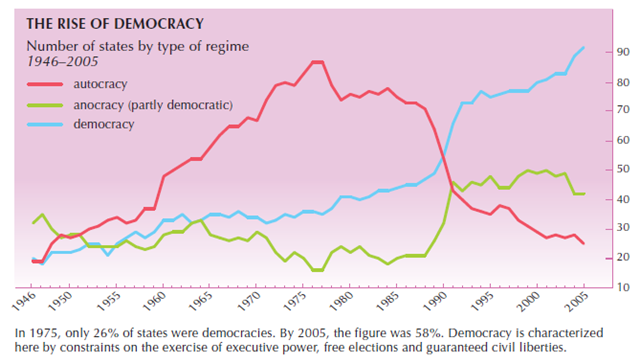
It all adds up to one overwhelming fact: the world is more at peace today than it’s ever been. With globalization clearly taking a dominant role in the lower-right structures of governments around the world, and therefore impacting the lower-left cultures of those nation-states, our planet continues to grow more peaceful as the years and decades roll on.
Much more good information is found in the miniAtlas.
The oil spill is not Ken Salazar’s or Barack Obama’s fault 2010-May-30 at 14:25 PDT
Posted by Scott Arbeit in Blog.Tags: Ken Salazar, Obama, oil, oil spill, Solar
8 comments
Time for Salazar to go?, by Mark Hertsgaard, 27-May-2010
No, it’s not. And this accident is not the President’s fault. And there’s nothing he could have done to prevent it. And there’s nothing the government could have done to stop the flow of oil by now. This is an unprecedented disaster — one mile below sea level — and there is no known technology to deal with it, so engineers are inventing solutions right now. It sucks, but that’s the situation. BP and Halliburton screwed up in terms of building the well, they didn’t have the kind of mission-critical safeguards they should have had, and it led to a total systems failure. My only complaint here is in terms of BP’s own processes to ensure that this kind of failure would never, ever, ever happen, which just weren’t nearly good enough.
And the only way that government regulators ever learn about these kinds of problems is in a reactive way, through some sort of systems failure. It seems to me that those who think otherwise are unfamiliar with culture and structure in large organizations. The bad hand we all got dealt is that, in this case, the level of failure that regulators could learn from wasn’t much smaller. With a partial failure, for instance, we would have been able to change the inspection regime to make sure that something this big would never happen. Unfortunately, the first failure was the biggest possible one.
We’ve seen this movie before with Obama. When Wall Street nearly crashed the global economy, Obama responded by listening to advisers—notably chief White House economic adviser Larry Summers and Treasury Secretary Tim Geithner—whose sympathies lay with the megabanks that gamed the system rather than with the ordinary Americans who paid the price in the form of unemployment slips and foreclosure notices. The bailout plan Obama ended up backing was a great deal for Wall Street, a terrible deal for Main Street. What’s more, the president allowed himself to be seen during the bank bailout drama as taking the side of the villains rather than the victims—a damaging and unnecessary political choice.
Now, Obama is in danger of making the same mistake with the BP oil disaster. Substitute Salazar for Geithner, substitute continued offshore oil drilling after the worst environmental disaster in history for continued lax banking regulation after the worst financial breakdown in decades, and the parallel is complete. In his final remark of the press conference, Obama drew the parallel himself, saying, “As in the financial markets, when big crises happen, it forces us to do some soul-searching.” Obama signaled today he wants to look tough on BP and demand exemplary behavior from the oil industry in general. But credibly standing up to Big Oil is difficult when your administration’s point man on the issue has long been the industry’s chief cheerleader and shows few signs of changing his views. If Obama truly wants to chart a new course in dealing with the BP disaster and accelerating America’s transition to a clean energy future, he should start by requesting Ken Salazar’s resignation.
The parallels being drawn in these last two paragraphs between the financial crisis and this crisis are so distorted as to be laughable. The assumptions are silly, and then the comparisons made between those silly assumptions and this situation stretch credulity. Calling Salazar “the [oil] industry’s biggest cheerleader”? C’mon.
No one is happy about this, and this kind of knee-jerk search for the guilty is what I’d expect from both the extreme left- and right-wing publications (such as The Nation), but a moderate point of view allows us calmly to realize that we’re just in uncharted territory here, and we’re making it up as we go.
Is this a wake-up call about alternative energy sources? I mean, sure, whatever. There was already enough profit motive behind moving to renewable energy (particularly solar) before this incident to have it developing as quickly as it could. It won’t come any sooner after this than it otherwise would have. It’s not about government investment in it, it’s about private investment and research, and it’s coming right on time, and much faster than most people realize.
President Obama loses exactly none of my support around this issue. He’s as frustrated and pissed as all of us are. If there was a reasonable solution that involved using the U.S. Navy Submarine fleet, or divers, or sinking a decommissioned ship over the hole, or detonating a mine down there, or anything that the military could do, it would have been done already. There’s nothing more that he can personally do… it’s up to the experts and the engineers now. And they’re doing everything they can think of.
US and Europe differ on fiscal policy 2010-May-30 at 06:22 PDT
Posted by Scott Arbeit in Blog.Tags: Europe, fiscal policy, Germany, Paul Volcker, stimulus, Timothy Geithner
add a comment
Geithner in Europe: US and EU Oceans Apart on Fiscal Policy, 27-May-2010
Europe is eager to begin paying down sovereign debt. The US wants to see Germany and France continue stimulus measures. With Treasury Secretary Timothy Geithner in Germany on Thursday, the trans-Atlantic differences in fiscal policy have become difficult to ignore.
…
But the camaraderie displayed on Thursday belied some recent tension in the trans-Atlantic relationship. For one, the US has not been impressed with Germany’s recent decision to ban certain kinds of naked short selling, considering it an unhelpful bit of unilateralism.
On a more fundamental level, however, Washington is concerned that, should Europe overreach in its rush to cut government spending, it could endanger the fragile economic recovery that has taken hold on the Continent and around the globe. In particular, the US would like to see countries like Germany and France continue efforts to stimulate their economies.
As I’ve mentioned before, I wholeheartedly support the move by the Obama Administration to pursue an international agreement on financial industry regulation and reform. Financial regulation, however, is not fiscal policy, and on fiscal policy we’re seeing some sharp differences between the US and the EU right now.
To some extent, I’m not surprised by this. The shock just felt in Greece, and therefore in the rest of Europe, has led many European leaders to draw the simple and obvious conclusion: debt and deficits are bad, and lead to bad outcomes. Germany is simply saying to Europe: we’re the most stable economy here, we can borrow currency at incredibly favorable rates, and even we’re not interested in debt and deficits anymore.
The sad fact is that the United States is still far more comfortable with deficits and debt than Europe is likely to be over the next decade or so. With that said, I appreciate the position that the Obama Administration – including Timothy Geithner, Paul Volcker, and Christina Romer – are taking: without fiscal stimulus, the entire world economy would have sunk, and it’s just too early to end that right now.
I have no impression whatsoever that the Obama Administration is in favor of endless high government spending; rather, I have the opposite feeling: that they’d love to cut spending as soon as they can, and as much as Congress will let them (and don’t forget, Congress makes the budget, not the President). Everyone in the Administration has made that clear at every opportunity. The important question remains: when is the right time to shift fiscal policy from stimulus to spending cuts?
There is much legitimate debate on this question. Unfortunately, the alleged science of economics brings us answers on both sides of the question, and so we’re left with the artistic choices made by various governments. Europe has one answer now; America has another. I believe that if the United States just went through a debt scare like Europe just did, that we’d be highly motivated in the short-term to cut spending as well. We haven’t – in fact, we’ve experienced a resurgence in the perception that the dollar is the most secure currency in the world – and so we continue to favor stimulus.
We all know that we’ll get to cutting the deficit, and paying down our debt, at some point… I’d rather it be sooner, because we need to start having the public debates about spending that will lead to a generational transformation in Congress.
And, of course, we need Congressional term limits. Desperately.
Afghanistan was rapidly modernizing… in the 1950’s and 1960’s 2010-May-29 at 06:26 PDT
Posted by Scott Arbeit in Blog.Tags: Afghanistan, globalization, Kabul
add a comment
Once Upon a Time in Afghanistan…, by Mohammad Qayoumi, 27-May-2010
These are amazing pictures, no doubt cherry-picked by the government at the time, but unthinkable today, of a Kabul that was westernizing in the 1950’s and 1960’s. Western clothing, record stores, medical labs… and then came the Islamic Revolution next door, and the Soviet invasion, and then a civil war, and then the Taliban takeover, and then the U.S. invasion.
No wonder no one in Afghanistan remembers this fragile peek into later levels of development, and why we now think of it as, in the words of British Defense Secretary Liam Fox, “a broken 13th Century country.”
Many assume that’s all Afghanistan has ever been — an ungovernable land where chaos is carved into the hills. Given the images people see on TV and the headlines written about Afghanistan over the past three decades of war, many conclude the country never made it out of the Middle Ages.
But that is not the Afghanistan I remember. I grew up in Kabul in the 1950s and ’60s. When I was in middle school, I remember that on one visit to a city market, I bought a photobook about the country published by Afghanistan’s planning ministry. Most of the images dated from the 1950s. I had largely forgotten about that book until recently; I left Afghanistan in 1968 on a U.S.-funded scholarship to study at the American University of Beirut, and subsequently worked in the Middle East and now the United States. But recently, I decided to seek out another copy.
Interesting. Here’s a snapshot. Two dozen more come with the article.
![100527_19-Afghanistan-148[1]](https://dawnoftheintegralage.com/wp-content/uploads/2010/05/100527_19afghanistan1481.jpg "100527_19-Afghanistan-148[1]")
Never forget that development is rooted in time, and that things rooted in time can both flourish and deteriorate. There is no guarantee of unbroken upward development, and Afghanistan is your proof. It breaks my heart, really, to see what this country has been through, and will be through for another decade or so. But globalization is coming… and once that gets into the system it’ll be hard to stop.
I look forward to visiting Kabul 20-25 years from now… it’s going to be glorious. Again.
Quantum dot amplifiers… that go up to 11 2010-May-28 at 17:21 PDT
Posted by Scott Arbeit in Blog.Tags: cpu, Moore's Law, quantum computing, Solar
add a comment
Moore’s Law reaches its limit with quantum dot amplifier, by Dana Blankenhorn, 25-May-2010
A Russian-Japanese team has created a quantum dot amplifier, an “artificial atom” that can amplify an electronic signal, a central electronic function. The announcement follows by three years the same team’s creation of a quantum dot laser.
Quantum dots are often called artificial atoms because, while they are made up of multiple atoms, they can be treated in theory like single atoms, and their electron shells can be manipulated.
The ultimate goal of quantum dot researchers is the construction of a quantum computer — replicating all of a computer’s functions on a nano-level. But the dots have other uses as well. As I wrote here in January they can make nifty solar cells, too.
They don’t really go up to 11. But they do start to address a fundamental limit to Moore’s Law: namely, that even though we’re making chips with smaller and smaller electronic pathways (Intel is manufacturing as small as 32nm right now), when we finally reach the size of individual atoms, we can’t go any smaller with current silicon-based technology.
Quantum computers take us off that path of miniaturization of existing technology, on to a whole new set of technologies that sidestep the problem, and carry us forward into a newer, far more powerful computing future.
And, like he said… this is good for the development of solar cells too.
I’m a sucker for an Ayn Rand reference 2010-May-28 at 08:25 PDT
Posted by Scott Arbeit in Blog.Tags: Ayn Rand, politics
3 comments
Instead of shrugging, Ron Johnson is running for office, by George F. Will, 27-May-2010
Before what he calls "the jaw-dropping" events of the past 19 months — TARP, the stimulus, Government Motors, the mistreatment of Chrysler’s creditors, Obamacare, etc. — the idea of running for office never crossed Ron Johnson’s mind. He was, however, dry tinder — he calls Ayn Rand’s "Atlas Shrugged" his "foundational book" — and now is ablaze, in an understated, Upper Midwestern way. This 55-year-old manufacturer of plastic products from Oshkosh, Wis., is what the Tea Party looks like.
He is trim, gray-haired and suddenly gray-suited. For years he has worn jeans and running shoes to his office, but now, under spousal duress, he is trying to look senatorial — "My wife upgraded me to brown shoes." He has been endorsed by the state party and will almost certainly win the September primary for the Republican nomination to run against Russ Feingold, who is seeking a fourth term in a year in which incumbency is considered a character flaw.
Former Republican governor Tommy Thompson led Feingold in polls and froze the race on the Republican side before deciding not to run. But in this season of simmering resentment of the political class, a neophyte such as Johnson might be a stronger candidate than a recycled executive. Johnson can fund himself. Asked how much of his wealth he will spend, if necessary, his answer is as simple as it is swift: "All of it."
I had a big Ayn Rand phase, too… it’s kinda sweet, in a weird way. If you didn’t, you missed out on a seminal experience growing up. It’s fun to be that certain that you’re right, while simultaneously being certain that other people are wrong. At least it’s fun when you’re young… but in your 50’s, I have less interest in seeing it in leadership and in Congress.
I believe that Ron Johnson’s motivation for running is rooted in a deeply felt sense of morals… but I still can’t support him. We already know what lies down the path of deregulation and the lack of government oversight, and it’s not the hidden capitalist lair, complete with gold-backed currency, of “Atlas Shrugged.”
Russians! Chess! Kremlin in control! 2010-May-27 at 18:04 PDT
Posted by Scott Arbeit in Blog.Tags: Anatoly Karpov, chess, Kasparov, Medvedev, Russia
add a comment
Russian Knights Joust to Control Chess World, by Michael Schwirtz and Dylan Loeb McClain, 26-May-2010
The conflict has pitted an alliance of two former world champions and onetime enemies, the anti-Kremlin activist Garry Kasparov and Anatoly Karpov, against high-ranking Russian officials. Mr. Karpov shocked Russia’s demure chess world this year when he declared his intention to seek Russia’s nomination for president of the World Chess Federation against the officials’ handpicked candidate.
The players have accused the officials of corruption, incompetence and, in the case of Kirsan N. Ilyumzhinov, a Russian provincial leader and the current president of the federation, mental instability. Mr. Ilyumzhinov, who has also been linked to the murder of at least one journalist, is supported in his bid to continue in the job by several top government officials, including the head of Russia’s Olympic Committee and a senior Kremlin adviser, Arkady V. Dvorkovich.
It’s true… the FIDE has screwed up royally in the last couple of decades. The behavior by the Kremlin in this spot, though, is beneath it, really.
Letting chess be run by professionals can only look good for Russia… for some reason they don’t see it that way. Too bad, and a sad commentary on the level of control being exercised there right now.
As they say about China: Russia… three steps forward, two steps back. They’ll get there eventually, and sooner if Medvedev lasts at all.

 The Dawn of the Integral Age