Stephen Wolfram on the computational universe 2010-Apr-27 at 20:40 PDT
Posted by Scott Arbeit in Blog.add a comment
What do we find when we explore the computational universe? Could it be that the complexity of the universe is based on just a few simple rules? What are candidate universes that might look like ours? Certainly, his approach is a very upper-right quadrant point-of-view, but still might be incredibly interesting. Video from TED is found here.
The demographics are in our favor 2010-Apr-07 at 22:41 PDT
Posted by Scott Arbeit in Blog.add a comment
Relax, We’ll Be Fine, by David Brooks, 5-April-2010
Over the next 40 years, demographers estimate that the U.S. population will surge by an additional 100 million people, to 400 million over all. The population will be enterprising and relatively young. In 2050, only a quarter will be over 60, compared with 31 percent in China and 41 percent in Japan.
…
In addition, the U.S. remains a magnet for immigrants. Global attitudes about immigration are diverging, and the U.S. is among the best at assimilating them (while China is exceptionally poor). As a result, half the world’s skilled immigrants come to the U.S. As Kotkin notes, between 1990 and 2005, immigrants started a quarter of the new venture-backed public companies.
The United States already measures at the top or close to the top of nearly every global measure of economic competitiveness. A comprehensive 2008 Rand Corporation study found that the U.S. leads the world in scientific and technological development. The U.S. now accounts for a third of the world’s research-and-development spending. Partly as a result, the average American worker is nearly 10 times more productive than the average Chinese worker, a gap that will close but not go away in our lifetimes.
I know it’s way more popular to talk about how everything is turning bad. The problem is… it’s not. Things are good, and despite the occasional hiccup, only getting better.
I do believe in the Law of Attraction, and so what we put our attention on tends to manifest. It’s an explicit goal of my work to try to get people to stop putting their attention on the outcomes they don’t want (global warming, financial collapse, renewed superpower confrontation, the list goes on and on) and get everyone focused on the outcomes they do want (reform of major religions, Integral politics, intelligent ecological and technological policies, music that doesn’t suck, etc.).
Bottom line… the United States is poised for a prosperous and healthy 21st Century. Deal with it.
New memory technology from HP 2010-Apr-07 at 22:31 PDT
Posted by Scott Arbeit in Blog.Tags: artificial intelligence, computers, memory
add a comment
H.P. Sees a Revolution in Chip-Making, by John Markoff, 7-April-2010
The researchers previously reported in The Proceedings of the National Academy of Sciences that they had devised a new method for storing and retrieving information from a vast three-dimensional array of memristors. The scheme could potentially free designers to stack thousands of switches in a high-rise fashion, permitting a new class of ultradense computing devices even after two-dimensional scaling reaches fundamental limits.
Memristor-based systems also hold out the prospect of fashioning analog computing systems that function more like biological brains, Dr. Chua said.
“Our brains are made of memristors,” he said, referring to the function of biological synapses. “We have the right stuff now to build real brains.”
Hmm… massive computational power? Computing systems that function like biological brains? You don’t say….
How to fix the Catholic Church 2010-Apr-07 at 14:51 PDT
Posted by Scott Arbeit in Blog.Tags: Catholic Church, conveyor belt, mythology
add a comment
Church: Norway bishop quit in ’09 over abuse, Associated Press, 7-April-2010
A Catholic bishop in Norway who resigned last year did so after admitting he had molested a child about 20 years earlier, when he was a priest, church officials said Wednesday.
The announcement came after a Norwegian newspaper pressed for an explanation for why Georg Mueller, a 58-year-old German, had stepped down unexpectedly as bishop in the western city of Trondheim in June 2009. At the time, Vatican and Norwegian church officials gave only vague reasons for Mueller’s departure.
Dear Catholic Church –
You don’t just have a P.R. problem. The issue is not that people are “attacking” the Pope. The problem is that you have covered up, for at least fifty years, that some of your priests are molesting children.
If you want this to go away… the answer is really, really simple. Turn over all of your records on child molestation to secular authorities, and make it clear to everyone in the world, especially your own hierarchy, that if you discover any new cases, they’ll immediately be turned over to the respective secular governments for prosecution. That’s all you have to do. It’s not that hard. Then your “problem” will go away because you will no longer be associating The Church with the scumbags who molest children.
It is really important to me that you clean this up and get healthy, because hundreds of millions of people around the world are counting on you for a healthy version of mythical religion, and we all need you functioning as well as you can.
Yours,
Scott
P.S. If you get a second, check out some of what St. Teresa of Avila was up to… she was on to something important.
Baseball returns 2010-Apr-03 at 16:33 PDT
Posted by Scott Arbeit in Blog.Tags: baseball
add a comment
Bare-handed reach
to catch
April’s
incoming curve.
Leap higher than you thought you could and
Hold:
Spring,
Solid,
Here.— Eve Merriam, “End of Winter”, published in A Sky Full of Poems (1964)
The rhythm of near-daily games returns. This is joy.
Inexpensive solar panels coming from Lowe’s 2010-Apr-03 at 16:23 PDT
Posted by Scott Arbeit in Blog.Tags: Solar
add a comment
Lowe’s move to sell solar panels will accelerate renewables, by John Dodge, 10-Dec-2009
The Andalay panels cost $893 each and the full 4,000 kilowatt system I have been envisioning would require 20-25 panels. But Andalay bills them as plug and play, suggesting easy installation and easy expansion as you go – you know, the stuff so-called experts will tell you can’t be done. Now it’s up to the utility companies to make tying into the grid plug and play.
This is the inevitable march of progress on solar energy. In a few years, even this system will seem low-end, but know that a power grid completely run on solar is coming.
How to write this in book form 2010-Feb-19 at 22:54 PST
Posted by Scott Arbeit in Blog.add a comment
I’ve been struggling with exactly how I was going to go about writing this book I want to write. I’ve never written a book before. I don’t know where to start. I mean, I have an outline for the book, but I don’t know if I should start writing at the beginning or in the middle, or just about what I’m feeling motivated by that day. Plus, I haven’t felt the strong sense that the outline is right.
I’ve also been unhappy about my neglect of this blog.
Something shifted for me in the last few days. First of all, I have a different kind of hook for what I want to write, so I’m feeling energized. Second of all, I realized that I don’t have to write the book right now… I can just keep writing blog entries as first drafts of what will become sections of the book.
So now I have motivation to do the blog, and motivation to write the book, all from doing the thing I want to do anyway… get my thoughts down in readable form.
So, here we go! For the foreseeable future….
Scott Brown wins in Massachusetts 2010-Jan-19 at 20:32 PST
Posted by Scott Arbeit in Blog.Tags: politics, Senate
1 comment so far
One comment… you realize that if the Democrats don’t get health care reform passed now that it’s not Scott Brown’s fault, right? It’s the Democrats’ fault for wasting an entire year doing absolutely nothing but arguing with each other.
There’s no cause large enough that the Democrats can’t screw it up and shoot themselves in the foot.
God please let there be Congressional term limits soon.
Haiti needs the SysAdmin 2010-Jan-14 at 11:14 PST
Posted by Scott Arbeit in Blog.Tags: Haiti, SysAdmin
add a comment
It’s clear to me, and to our top-level military planners, that we need to have both a war-fighting force and a peace-making and reconnection force, which Thomas Barnett calls the SysAdmin.
Our efforts in Iraq since 2004, and our efforts in Afghanistan starting in 2009, have been all about building the capabilities required to effectively run the SysAdmin.
Unfortunately, because these first two efforts have come after our Leviathan, war-fighting capability has done its job, many people are resistant to it, simply because we’re doing it after fighting.
OK… so let’s do a SysAdmin effort – sustained reconnection, lasting 8-10 years, building government institutions and inviting FDI and connectivity – in Haiti. Let’s do it where it wouldn’t be “tainted” by having invaded first (leaving aside for now the question of the conditions under which such invasions should be done).
Let’s do it where some of the American public wouldn’t be resistant to it up front. Let’s do it in a way that invites other nations to participate, and trains them in what such an effort would ask of them. Let’s do it where NGO’s other than the U.N. get involved. Let’s do it where the only shooting we’ll be doing is against criminals, not “insurgents”.
Let’s get used to doing it, because we’re going to be doing it anyway, all over the world, for the next 40-50 years. Let’s get the world used to it, comfortable with it, and expecting the benefits of it.
I’m not sending any text messages to send $5 to Haiti. It doesn’t matter. This does. Let’s all get behind a serious, mature, well-conceived, long-term SysAdmin effort in Haiti to once-and-for-all move that nation up from the hell it was even before the earthquake to a fully-connected part of a globalized world.
Windows 7 performance on modern hardware is amazing 2010-Jan-13 at 15:16 PST
Posted by Scott Arbeit in Blog.add a comment
Windows 7’s killer feature: Windows on multicore, redux, by Randall C. Kennedy, 13-Jan-2010
Simply put, Windows 7 is significantly faster than Windows XP when running heavy, multitasking workloads on advanced, multicore hardware. And when considered in light of current trends in PC hardware design and multicore road maps, this advantage should be enough to sway even the most ardent fence sitters to finally jump on the Windows 7 bandwagon.
…
All of those advantages that make Windows 7 so compelling — the improved security, manageability, and usability features — come at a cost in terms of additional CPU cycles consumed by their respective background services. Thus, making the most of what processor bandwidth is available takes on a new urgency as the layers of software separating hardware from operator continue to accumulate.
But no matter how you slice the results, Windows 7 — or at least its underlying kernel architecture — is clearly the future of Intel-based PC computing. This will remain true even if Microsoft decides to gut Windows and do away with all the layers above the NT Executive (MinWin taken to the extreme). The fact is that Microsoft has built a robust, highly scalable, multicore-aware OS foundation with Windows 7, and it should continue to serve Redmond well as it maps out future versions of the OS.
Simply put, Windows 7 kicks ass. It kicks ass in user experience, it kicks ass in device compatibility, it kicks ass in media rendering, and it seriously kicks ass in raw multi-processor performance. The kernel is amazing, the UI is amazing, and if you’re still on XP or Vista, it’s time to make the move.
And for a server, Windows Server 2008 R2, which is essentially the same kernel as Windows 7, is an incredible platform. Can’t wait to build a new server at home.
As technology improves, the gaps between generations grow 2010-Jan-11 at 23:13 PST
Posted by Scott Arbeit in Blog.Tags: generations, Technology
add a comment
The Children of Cyberspace: Old Fogies by Their 20s, by Brad Stone, 9-Jan-2010
Researchers … theorize that the ever-accelerating pace of technological change may be minting a series of mini-generation gaps, with each group of children uniquely influenced by the tech tools available in their formative stages of development.
“People two, three or four years apart are having completely different experiences with technology,” said Lee Rainie, director of the Pew Research Center’s Internet and American Life Project. “College students scratch their heads at what their high school siblings are doing, and they scratch their heads at their younger siblings. It has sped up generational differences.”
No big surprise here… as the pace of technological change increases, the time it takes to create differences between older and younger will decrease. This probably continues until there are noticeable differences in groups as close as only two years apart.
Children born today in the United States likely won’t remember a time when monitors weren’t multi-touch, when video games didn’t respond to voice as a matter of course, or when animated movies weren’t all 3-D (among lots of other trivial predictions).
My new neighborhood supermarket opens Wednesday 2010-Jan-11 at 15:52 PST
Posted by Scott Arbeit in Blog.Tags: Ballard, Seattle
add a comment
Yes, yes, I know, this doesn’t seem like something to get all completely excited about. But, you have to understand… this is a brand-new supermarket, in a brand-new building, that’s just 300 feet from my house. As in… I can just walk over there whenever I feel like it, day or night, and get whatever I need. Urban living at its finest. Here are some lovely highlights, courtesy of my awesome neighborhood blog My Ballard.
The center-of-gravity of Integral will be Yellow/Strategist 2010-Jan-11 at 00:18 PST
Posted by Scott Arbeit in Blog.Tags: Green, Individualist, SDi, Strategist, Yellow
add a comment
I have struggled a bit in the past few days with how to reconcile a number of points-of-view with the notion that the future is not entirely unpredictable.
I’ve been aware for some time that aspects of the future I’m seeing for the Integral movement will be a hard sell for those at particular levels of development. Much of what I say in regards to Dr. Thomas Barnett will be difficult to hear for Green/Individualist***, who have the beautiful capacity to see clearly that there are multiple (in fact, an infinite number of) perspectives or contexts for any given event. This, to me, is the single greatest contribution from post-modern philosophy; namely, that there is no pre-given world, and all views on that world are co-created by the person doing the viewing, but Green or Individualist generally cannot or does not prioritize those multiple contexts in terms of their viability, usefulness, or long-term effects.
For very different reasons, much of what I’ll say about the future will be rejected by those at early Magician, or early construct-aware. From that perspective, the very notion that there are contexts is subsumed by questioning of the constructs in which the contexts themselves sit. It’s been my experience with those who are firmly rooted in early construct-aware that it seems far more important to sit in unknowing about existence, and to be open to whatever emerges from that unknowing, than it is to choose a set of constructs (and contexts) and act as if they were true. For me to take firm positions about what I think are the best choices to make for the health of the Integral movement, and the health of the world, violates the notion of allowing emergence to happen as it will, as I’m imposing a construct onto a reality that is, at it’s core, non-dual and without construction. Even discussing levels of development, or centers-of-gravity within people or populations, becomes a challenging task, as the constructs in which one might consider something like a center-of-gravity are deconstructed as arbitrary.
To some extent, I understand both perspectives. The contributions of healthy post-modernism remain crucial to our understanding of psychology, language, systems theory, social justice, and dozens of other areas, and those valid contributions remain as a part of Integral theory. I also have felt the vast openness of early construct-aware. I have some awareness of the way that questions feel more important than the answers, as answers only close doors or limit the possibilities that questions open.
There will be some in the first generation of Integral (which I define as those of us who have found Integral up to now, and for the next few years… mostly self-identified spiritual seekers, some of whom will create the cultural artifacts that attract the second generation) who, thanks to their unabated drive to grow, and the support of friends walking the same path in communities around the world, push into these construct-aware structure-stages. Very little research exists on what these structure-stages look like, as very few people have yet achieved them. I expect that we’ll see quite a bit of research in the coming decades on this level of development. We’re just starting to see more than a trickle of people who might test at these levels, and who therefore might be able to give consistent reports of the worldviews disclosed from those perspectives.
For all I know, I’m starting to feel into it myself… and there are moments when I think I am. I also acknowledge that it’s particularly dangerous and untrustworthy to rate one’s own development, so I hold this very, very lightly in the absence of more formal methods of evaluation.
And yet… I believe that the center-of-gravity of the Integral movement will be Yellow in terms of SDi, and Strategist in terms of LMF. I believe this because the center-of-gravity of the previous major philosophical movement, post-modernism, was Green/Individualist, and it seems unlikely to me that Integral will be able to shepherd a mass movement for the center-of-gravity of billions of people through two levels of development to get to Teal/Magician. For Integral to succeed in moving the center-of-gravity of the Western World one structure-stage up from Green to Yellow, and Individualist to Strategist, would be an amazing achievement, and would unlock a global potential to solve the vast majority of the major problems facing the world today (while creating the life conditions for new problems to emerge, of course).
With that said, I think it’s important to acknowledge that I will target my writing and thinking, for the most part, at what I expect to be the center-of-gravity of Integral for the next 20-30 years: Yellow/Strategist. I think it’s most important that the things I’m focusing on get out to that audience as much as possible, as that’s where they’ll do the most good.
To my friends who already have amazingly, blessedly grown past even this incredible structure-stage into newer, vaster perspectives: today I’m thinking that you won’t be my audience, and that’s OK. Perhaps I’ll change my mind over time, but now I don’t think the world can wait to sit in unending questions and open-ended answers… I haven’t yet seen solutions that minimize suffering in the world coming from that perspective. In fact, so far in my small sample I’ve seen quite a lot of suffering from those in early construct-aware. There will come a day – a day beyond Strategist and Integral – when the world is stable enough to allow for the kind of open-ended inquiry at Magician on a widespread basis, but I don’t think that time has yet come, nor is it likely to in the next few decades. My deepest appreciation to all those who embark on that path, and therefore dig the Kosmic grooves that others will follow.
Call me a pop artist, but I’m writing for where I think most interested people will be, not for the farthest reaches of development. I’ll leave that job to those more interested and more qualified than I am.
*** If you’re not familiar with the terms from the Leadership Maturity Framework (LMF), you’ll find a comparison between Spiral Dynamics Integral (SDi) and the LMF, created by the good people at Integral Development Associates, here. You can find a brilliantly-written short explanation of the structure- and state-stages of the LMF, written by Terri O’Fallon, Ph.D, here.
Paris… the European capital of Boredom 2010-Jan-10 at 23:07 PST
Posted by Scott Arbeit in Blog.Tags: Paris
add a comment
Revelers See a Dimming in a Capital’s Night Life, by Scott Sayare and Maia de la Baume, 10-Jan-2010
Despite its reputation as the bustling spiritual home of the bohemian, the city has in recent years grown ever less mirthful and ever more staid and bourgeois, club owners say. Faced with mounting noise complaints, fines and closings, many Parisian bars and concert halls are struggling to stay afloat. D.J.’s and musicians have also been abandoning the French capital, forcing a startling conclusion upon the city’s night life professionals: Paris may soon be dead at night.
…
A sampling of the city’s problems: densely packed, mixed-zoned neighborhoods; a lack of late-night transportation (the last metro leaves at 2 a.m. on the weekends, 1 a.m. during the week); and an unwieldy tangle of rules and regulations on bars and nightclubs, applied with uncommon zeal by a “repressive” police force.
Club owners say the central issue is the city’s accelerating gentrification. Real estate values have more than doubled here in the past 10 years, and residents increasingly demand peace and quiet, the club owners say.
I’ve only been to Paris once, but I’ve heard this story from a few different news sources lately, and it kind-of makes me sad, particularly when I think about the thriving night scene in Budapest. The Left Bank, Bohemian, loud, fun image of Paris from the height of post-modernism seems to fade away now. I’d have to say that anytime we see a prediction like “Paris may soon be dead at night” it’s probably hyperbole… but it’s amazing that we’re even reading it at all.
There’s talk of allowing some late-night permits in Seattle, and I’d love to see that happen. I’m hardly a club-scene person, but a city that allows for 4 AM or later is a thriving city and a place that invites youth and energy and turnover.
Chávez continues to screw Venezuela into the ground 2010-Jan-08 at 23:55 PST
Posted by Scott Arbeit in Blog.Tags: Hugo Chavez, nationalization, Venezuela
add a comment
Chávez Devalues Currency Amid Oil Fall, by Simon Romero, 08-Jan-2010
“This announcement does not transmit confidence in economic stability,” said Orlando Ochoa, an independent economist here. “There is still no program in place to control inflation.”
…
But other subsidies, including a policy that keeps gasoline priced at less than 10 cents a gallon, drain resources. And private businesses here, fearful of abrupt nationalizations and expropriation threats by Mr. Chávez, are hesitant to increase investments, denying the economy a source of vitality at a time of stagnation and high inflation.
Venezuela is a train-wreck in slow motion. It does provide an interesting economic case for intervention. Now that he’s gotten himself elected as leader-for-life (although he claims there are free elections), I wonder if and when the world will begin to look at what he’s done and decide that it’s best for the stability of all of South America that he goes away. He’s already removed almost all opposition media, and imposed new ways of appointing politicians so he controls them. Will it take until he declares himself supreme leader and suspends all civil rights? Will it take until he declares martial law? Will he have to go to war with Colombia before it happens? Will it take mass starvation due to his inept policies? Or will we all just watch as millions of people suffer under one of the most repressive regimes in the world over the next ten to twenty years?
The longer he’s around, the more difficult the job will be to get Venezuela reconnected to globalization. The infrastructure there is already crumbling, the stores already have shortages of everything. The only thing they have that connects them with the world is oil… just like the Middle Eastern nations that we already know are in desperate need of reform.
The presentation is unleashed 2010-Jan-08 at 23:40 PST
Posted by Scott Arbeit in Blog.Tags: presentation, Seattle Integral
2 comments
I gave the presentation on The Future of Integral to my friends at Seattle Integral on Wednesday night. It was the first time I’ve given it publicly to a large group. Really grateful to everyone who came, and who has given me feedback. And I’m particularly grateful to those of you who sat through my first two small sessions to just get some practice before I did this one… your help meant so much to me.
I haven’t even been able to comment much in the last couple of days, as I was fairly sick with a cold and cough when I gave the presentation, and my body basically collapsed afterwards. I was very sick at work on Thursday, got home and literally passed out on the couch, and then stayed home on Friday… as I write I’m about to go to bed for what I hope will be nine or ten hours to try to knock it out completely.
Ultimately, doing this presentation is just telling a story that I hope weaves things together in a coherent and sometimes provocative way. And, like all storytellers, I have to develop some skill. I also realize that doing this is a lot like doing comedy… if I’m doing it really well, there’s a wave of energy in the crowd that I get to push and pull on in just the right amount to make everyone feel energized. I do feel a lot like a comedy writer who just went to do his new routine for the first time… some of it worked, some of the jokes need to be rewritten, and I need to get better at delivering the material either way.
And this is just the beginning… I’m really excited about all of this, now more than ever. Good things are coming… the future of Integral, and the future of the world, are very bright indeed.
The Iranian regime eventually will collapse on its own 2010-Jan-03 at 20:31 PST
Posted by Scott Arbeit in Blog.Tags: film, Iran, non-violence
add a comment
Iranian Filmmakers Keep Focus on the Turmoil, by Michael Slackman, 03-Jan-10
Iran’s government cannot silence the filmmakers.
It keeps trying. Films are censored. Directors are prohibited to leave the country and prohibited to return home, forced to cancel projects and threatened with punishment if their films are too probing or too critical of life in the Islamic Republic.
But the films keep coming, and so do the filmmakers.
I’ve been thinking a lot about non-violent protests, and where they work. It seems to me that you can’t use non-violence against a (using Spiral Dynamics’ terms) RED or RED/blue insurgency… they need to be attacked and killed if required for the health and safety of the surrounding people. In a nation that claims to have a constitution, like Iran (BLUE or even BLUE/orange), non-violent protests against the government are highly effective, showing the inconsistency between the laws and the way that they’re applied.
When I think about the two most famous non-violent movements in the 20th Century — namely, civil rights in America led by Dr. Martin Luther King, Jr., and Indian independence led by Mahatma Gandhi — they were both examples of using non-violence against a government that had some laws from Orange… and that’s why they ultimately were successful. The governments yielded to the inconsistency.
Iran is well on its way to regime change… and I’d love to see the United States and Europe lend more vocal moral support, and perhaps some resources, to the mostly non-violent movement there to see the government change.
The military learns quickly from its own mistakes 2009-Dec-30 at 22:16 PST
Posted by Scott Arbeit in Blog.Tags: COIN, history, military
add a comment
Army History Finds Early Missteps in Afghanistan, by James Dao, 30-Dec-2009
“A Different Kind of War,” which covers the period from October 2001 until September 2005, represents the first installment of the Army’s official history of the conflict. Written by a team of seven historians at the Army’s Combat Studies Institute at Fort Leavenworth, Kan., and based on open source material, it is scheduled to be published by spring.
…
Though other histories, including “In the Graveyard of Empires” by Seth G. Jones and “Descent Into Chaos” by Ahmed Rashid, cover similar territory, the manuscript of “A Different Kind of War” offers new details and is notable for carrying the imprimatur of the Army itself, which will use the history to train a new generation of officers.
As always, the military is forced to adapt quickly to unexpected circumstances, and it’s good to see their own evaluation of what they did and what had to change to succeed. I look forward to reading at least some of it. My expectation for our efforts in Afghanistan in 2010 is that our men and women in the military will have a fair bit of success, mostly because we did it the wrong way already, and we know what to do better now. This book is the proof.
We need this kind of deep and honest self-reflection as we adapt the military to the long-term “winning the peace” initiatives we’ll be sure to take on in the next 40 years or so.
The New York Times’ copy of this document is here.
No flying cars, and no Smellevision 2009-Dec-30 at 21:59 PST
Posted by Scott Arbeit in Blog.Tags: cartoon
1 comment so far
I kind of wanted to use the first two minutes or so (up to the newspaper) of this in my Future of Integral presentation somehow, but it just doesn’t survive a serious edit. You know, something like “well, Looney Tunes had it covered up to 2000, now what do we do?”
It is, however, fun to watch anyway.
One would think Mac users would be offended… 2009-Dec-30 at 08:49 PST
Posted by Scott Arbeit in Blog.Tags: computers
2 comments
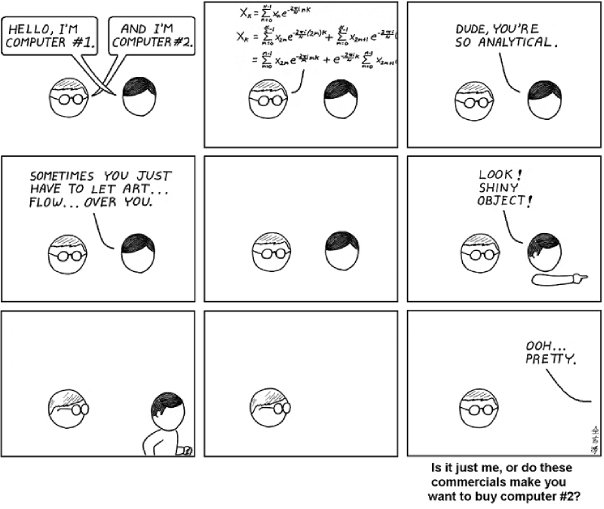
…by the implications of these commercials.

 The Dawn of the Integral Age